
Garden ideas
For those lucky enough to have a garden of their own, there are many things you can do to both reduce your own environmental impact and even improve your local natural environment.
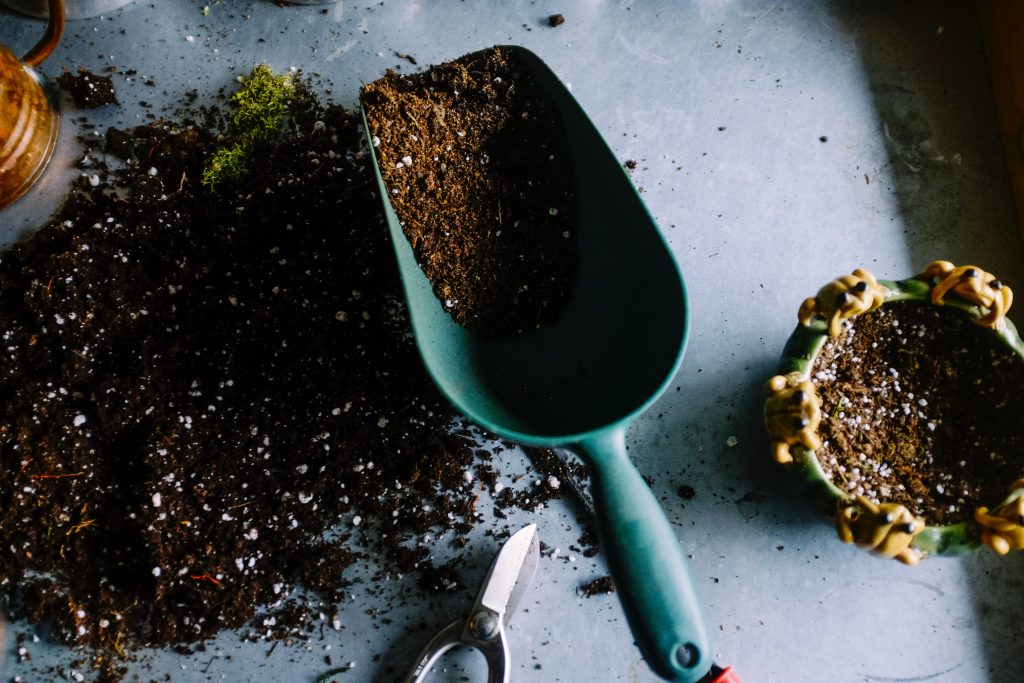
Avoid peat-based compost
Peat is an accumulation of partially decayed vegetation unique to natural areas such as peatlands, bog and moors. It is a very effective carbon sink, globally storing 550 gigatonnes of carbon dioxide, and is a unique habitat for certain animals and plants.
Peat-based compost is created by digging up the peat – in the UK for instance, apparently 95% of all peat bogs have now been removed, and it can take thousands of years to accumulate more. Not only does mining peat destroy these habitats, it also releases large amounts of CO2. As all the UK’s peat is gone, it now needs to be brought in from other countries, generating further CO2.
To avoid this, simply buy peat-free compost from your garden centre, most of them will tend to have peat-free alternatives, though it can cost slightly more than the peat-based stuff.
Create your own compost pile
One thing you can do to reduce the amount of compost you need to buy in for your flower / vegetable beds is of course create your own. Getcomposting.com has teamed up with local authorities to offer reasonably-priced compost bins, made out of recycled plastic.
Get one of these, and fill it with all your organic waste. This includes fallen leaves from trees in your garden, food waste from fruit and vegetables, plus grass clippings. However, a whole load of grass clippings dumped in in one go can have a tendency to clump and not break down properly – I find putting half in to begin with, then leaving half outside for a few days until it dries out, then mixing it in, works better.
There are many online resources to give you tips on how to effectively compost, such as the Royal Horticultural Society. “Cold composting” is the type that most average homes will have. “Hot composting” is where very large amounts of material are added in one go, more suitable for farms – this approach is faster to decompose, but not really practical for most average homes.
Start a wormery
As mentioned, cold composting is slower than hot composting, and can take many months to achieve ready compost. A quicker way to get ready compost (albeit in smaller amounts) is with a wormery. These are not the small “worm farms” you might’ve had or seen as a kid, they’re more like beehives for special compost worms. You buy a wormery (Worm City is where I got mine from), add worms to the bottom tray and gradually fill it with food waste. The worms (and bacteria, fungi, small insects) then gradually turn this into compost. When they’re finished, they migrate to the next tray which you’ve been filling with food, you take out the old tray and empty it onto your garden.
There are supposedly many benefits to worm castings (what the soil is called that’s passed through the worms) – that it’s got more nutrients, etc. There is a bit of debate as to the strength of these claims, but certainly no-one is saying it’s a bad thing. And composting this way in your own garden helps to reduce the energy needed to transport your waste elsewhere and means you need to buy less compost yourself, so all round a good thing.
Try “Bokashi” composting
This is another composting technique for people that don’t have as much space or waste to get through, that uses fermentation rather than bigger organisms to break down the waste into compost. I don’t know a great deal about it, so do check out other resources.
Attract bees
Bees and other pollinators are of course crucial to the ongoing survival of much of the vegetation that we rely on, so anything you can do to help these creatures out is a good thing. That basically means introducing as many different flowers as you can to your outside space, even if that’s just a window box. Wildflower seeds are relatively cheap to buy, and some of the wildflowers will produce more seeds you can plant next year.
While many think of bees as living in beehives, actually only a small number of species live in this way. The vast majority of bee species are “solitary bees”. As the name suggests, they don’t live in a community: they hatch, wander around eating pollen, then create their own little nest with a few eggs in, before dying. The places they choose for nests are essentially empty tubes – the other day I saw a bee going in and out of a drilled hole in the side of my garage. The next day I looked again and it had been plugged by the bee, hiding the eggs away. You can encourage this sort of behaviour by building or buying a bee hotel – essentially a bunch of hollow bamboo rods stuck together.
Add a water butt
Capturing the water falling on your roof for use in your garden has several benefits, including saving money for yourself if you’re on a water meter and making sure you have water on hand even during hosepipe bans. It also helps to save energy, using local rainwater rather than water cleaned for drinking purposes and pumped from afar; reduce strain on the water system during droughts, and to reduce flood risks.
Water butts are fairly easy to install on any downpipe you have with an adaptor kit, although it does involve sawing through the pipe and replacing the cut-out section with a piece that diverts water into the butt rather than the drain, until the butt is full.
Discounted 100L and 200L water butts are available from water-saving campaigns such as Save Water Save Money or sometimes from your local water authority.